
“This is a book that every economist, historian, and politician should read.”
â Amity Shlaes, syndicated Bloomberg News columnist
“The greatness of America lies not in being more enlightened than any other nation, but rather in her ability to repair her faults.”
â Alexis de Tocqueville
As we teeter on the brink of the âfiscal cliff,â Americans face a trifecta of economic challenges: sequestration, entitlement reform, and a Molotov cocktail of tax increases all threaten to plunge the nation deep into a new recession.
Will we respond to these challenges by doubling down on what has not worked to date, on policies which are alarmingly similar to those of our Social Democratic friends in Europe? If the Democrats under President Obama get their way, the answer is surely âyesâ.
But a timely and sobering new book explains why we cannot ignore the âcanary in the coalmineâ across the pond in determining our economic future.
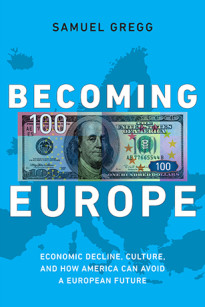
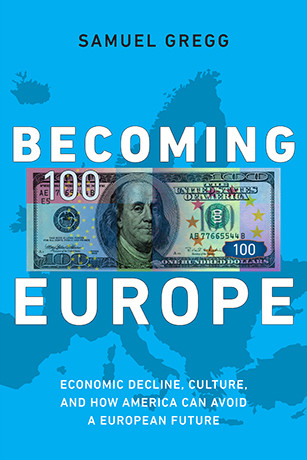
Samuel Greggâs Becoming Europe exposes the true scope of the crisis gripping our Transatlantic cousins: the crush of enormous debt, governments consuming close to fifty percent of the economy, high taxation, sharply aging populations, crony capitalism, and staggeringly high numbers of public-sector workers being supported by an ever-dwindling class of private-sector employees.
Most alarmingly, Becoming Europe reveals that America has already moved in the direction of the European welfare stateâmuch closer than most Americans realize.
How can we turn back? Gregg prescribes a return to the American spirit of entrepreneurship and innovation, the very spirit that can not only curb Americaâs drift towards what Alexis de Tocqueville called the âsoft despotismâ of Europe, but reinvigorate the American Experiment. In this, Becoming Europe also provides a blueprint for American Conservatives to emerge back from the political wilderness.
In this eye-opening and sobering book, Gregg reveals:
Samuel Gregg is director of research at the Acton Institute. He is the author of many books, including the prize winning The Commercial Society (2007). He lectures regularly in America and Europe on topics including political economy, economic culture, and morality and the economy. His writings have appeared in publications including National Review, The American Spectator, and Crisis Magazine.
Some Questions and Answers:
1) Is Becoming like Europe really such a bad thing?  Long vacations, free healthcare, early retirement, etc.
Yes, it is. The future of Europe is Greece. And unless we do something, the future of America is California. Just ask the thousands of Californians and businesses who have fled the land of Nancy Pelosi if that is a âbad thingâ.
2) Is our fiscal cliff really a âThelma and Louiseâ moment for America? Will we become like Greece overnight?
Rome wasnât burnt in a day. The United States still can turn it around but it must get its American mojo back, and give up on Europe Envy.
3) Isnât there a divide between American rhetoric and reality when it comes to the economy?
Many Americans boast of free enterprise and free markets, when many are in fact reluctant to roll back state intervention when it benefits them directlyâie subsidies for their particular industry or state.
4) But isnât the world becoming more Americanized? McDonalds and Hollywood dominate the globe.
All economic indicatorsâthe debt, rising entitlements, increased regulationsâpoint to the American economy becoming Europeanized over the last ten years, but particularly since 2008.
5) In November the American People voted for the candidate that promised security over the candidate that promised a return to competiveness and growth. Isnât this what they want?
We canât afford our entitlement system. Â Part of the problem is Americans havenât really been asked to pay for it yet. The emerging debates on taxation and entitlements will tell us just how much Americans want to become Europe.
âWeâre becoming like Europe.â This expression captures many Americansâ sense that something has changed in American economic life since the Great Recessionâs onset in 2008: that an economy once characterized by commitments to economic liberty, rule of law, limited government and personal responsibility has drifted in a distinctly âEuropeanâ direction.
Across the Atlantic, Americans see European economies faltering under enormous debt, overburdened welfare states, governments controlling close to fifty percent of the economy, high taxation, heavily regulated labor markets, aging populations, and large numbers of public sector workers. They also see a European political class seemingly unable â and, in some cases, unwilling â to implement economic reform, and seemingly more concerned with preserving its own privileges. Looking, however, at their own society, Americans are increasingly asking themselves: âIs this our future?â
In Becoming Europe, Samuel Gregg uses the idea of economic culture â the values and institutions â that inform our economic priorities to explain how European economic life has drifted in the direction of what Alexis de Tocqueville called âsoft despotismâ, and the ways in which similar trends are manifesting themselves in the United States. America, Gregg argues, is not yet Europe. Economic decline need not be its future. The good news is that the path to recovery lies deep in the distinctiveness of American economic culture. But there are ominous signs that some of the cultural foundations of Americaâs historically-unparalleled economic success are corroding in ways that are not easily reversible and for which the European experience should serve as the proverbial canary in the mine shaft.