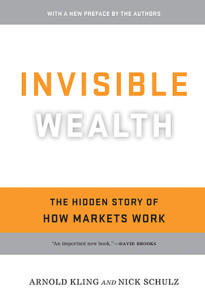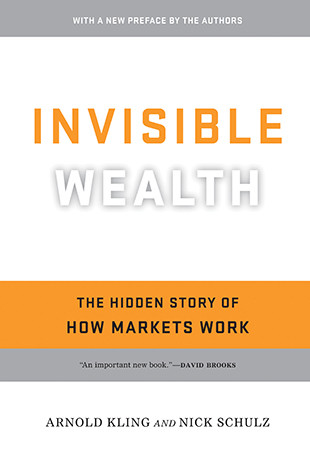
Praise for Invisible Wealth, previously published as From Poverty to Prosperity
Over the past decades, many economists have sought to define the differences between the physical goods economy and the modern protocol economy….Their research is the subject of an important new book called ‘From Poverty to Prosperity,’ by Arnold Kling and Nick Schulz.
David Brooks
Kling and Schulz present a new line of economic reasoning—‘Economics 2.0’—that focuses on innovation, rather than government intervention, to solve market failures. This book is particularly timely given the current financial crisis. Kling and Schulz demonstrate why a costly, government-driven recovery attempt is unlikely to lead to sustainable growth and may even lead to greater losses in the future. By offering concise, easily understandable chapters that are supplemented with interviews with well-respected economists, Kling and Schulz provide a text that is comprehensive without being burdensome. From Poverty to Prosperity makes a persuasive argument for limited government intervention in the free market, and empowering the individual.
Newt Gingrich, former Speaker of the House, author of Real Change
FPTP leaves you with one key idea… The prosperity of countries now depends more on human institutions, innovations, and know-how than on material factors. Politicians and policymakers need to understand that strengthening those intangible assets is more important than short-run economic management.
Joseph Lawler, The American Spectator
A fascinating blend of interviews and perspectives on where economics—and the economy—is heading. A must read for anyone who thinks economists are out of touch with today’s reality or don’t have competing compelling visions for the future.
Simon Johnson, Ronald Kurtz Professor of Entrepreneurship at MIT’s Sloan School of Management, former chief economist at the IMF
Arnold Kling and Nick Schulz show you how to think like a new economist, updating the conventional scarcity toolkit with their ‘one big story’ on innovative entrepreneurship. This is the antidote to shallow, static pessimism about our economic future. Books about economics have proliferated in recent years, but From Poverty to Prosperity finally tells us about the important new ideas proliferating among economists. In this series of interviews with breakthrough thinkers inside the profession, Kling and Schulz offer the single best summation of new thinking on growth and development that I have seen, and their presentation is fantastic.
Bob Litan, Ph.D., Vice President, Research and Policy, The Kauffman Foundation and Senior Fellow, Economic Studies, The Brookings Institution
If more taxpayers read this book they’d be better prepared to vote for policies that keep America a place where workers become more, not less, productive, when they arrive here from their countries of origin.
Ira Stoll, editor of FutureOfCapitalism.com
The central thesis of this book is that mainstream economics, with its emphasis on labor and capital and its focus on the efficient allocation of an economy’s output, is not so much wrong but utterly misleading in its understanding of modern economies, especially that of the United States.
Richard Cooper, ForeignAffairs.com
The book makes the arguments about the evolutionary or emergent nature of economic outcomes, and the importance of markets rather than planning, in a clear and readable way.
Diane Coyle, author of The Soulful Science