What happens when a society advances further than any society before—but its people find themselves more lonely, empty, and fractured than ever?
Millennials, Zoomers, and Gen Alpha were supposed to be the happiest, most educated, most productive—and especially most progressive—generations in history, surpassing their forebears by every metric. Yet, as they learned to walk, talk, and think alongside the bloom of digital technology and the decay of tradition, they have instead become more anxious and unhappy, and less financially secure.
Nearly half a century ago, philosopher Alasdair MacIntyre predicted that the West would slide into a new dark age in which we would seek to free ourselves from the apparent limitations of the past, of morality, of ethics, and of authority, but in doing so, dismantle the framework that gives us coherence, transcendence, and shared meaning.
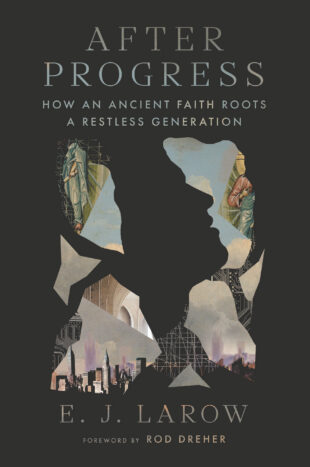
In After Progress, E.J. LaRow argues that the dark age is upon us.
Drawing on three twentieth-century thinkers who saw it coming—Robert Nisbet, Max Picard, and Christopher Lasch—LaRow diagnoses the rootless modern self with uncommon clarity: how the promise of self-fulfillment brought about the dissolution of community bonds; how the pursuit of inordinate freedoms wrought new forms of enslavement; how new tools for connection made us disconnected and lonely.
LaRow’s answer to the loss of our unifying narrative is as radical as it is ancient. In our modern age, he argues, we have become estranged from the only story that can tell us the truth about our existence and can offer a home to the homeless and fragmented self. That loss cannot be repaired through better politics, more sophisticated therapy, or relentless scientific advancement, but only by returning to an institution far older than any of them. A home for the restless self, a story that does not revise itself, a community that makes binding demands and keeps binding promises: the church.